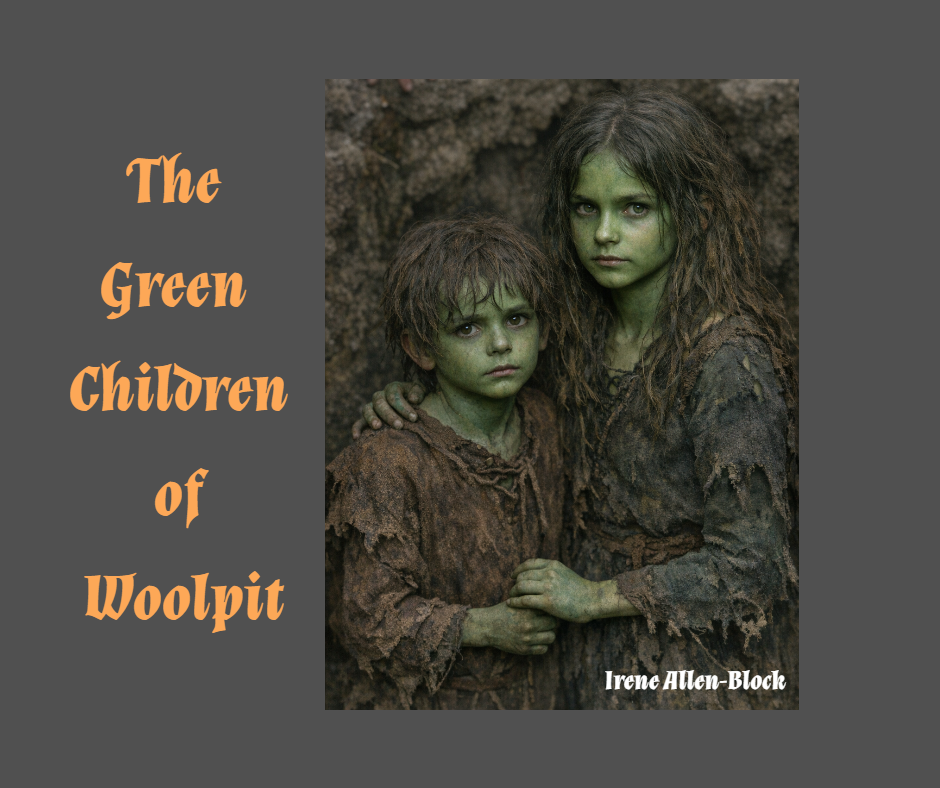
The legend of the Green Children of Woolpit has lingered for centuries, not because it offers answers, but because it refuses to. It is a story that sits uneasily between history and nightmare, an intrusion of the inexplicable into the quiet rhythms of medieval life. When retold through a darker lens, the tale becomes less a quaint curiosity and more a reminder of how thin the boundary can be between the familiar and the unknown.
A Village on the Edge of the Wild
Woolpit in the 12th century was a place perched between safety and threat. Dense forests pressed close to the fields, and the villagers dug deep wolf pits to keep predators at bay. These pits were meant to trap beasts, but on one late-summer day, they caught something far stranger.
Harvesters heard a sound rising from one of the pits: not the growl of a trapped wolf, but the thin, wavering cries of children. When the villagers peered over the edge, what they saw unsettled them to the core.
Two children stood in the shadows below, pale, trembling, and unmistakably green. Their skin held the colour of bruised leaves, as though they had been stained by some otherworldly light. Their clothing was woven from a fabric no one recognised, and their eyes darted wildly, as if the world above the pit was too bright, too loud, too real.
The villagers brought the children into the light, but the sunlight seemed to wound them. They cried out in a language that twisted strangely in the air, melodic, but sharp at the edges, like a song sung backwards.
When food was offered, they recoiled. Bread, fruit, meat, everything was refused. Days passed, and the children grew weaker, their green skin taking on a sickly pallor. Only when someone brought freshly picked broad beans did they react. They tore into them raw, devouring them with a desperation that made the villagers uneasy. It was as though the beans were not food, but a lifeline to whatever world they had come from.
Sir Richard de Calne took the children into his home, but even there, safety was an illusion. The boy, always the more fragile of the two, began to fade. His green hue drained from his skin, leaving him ghost-pale. Some said he was homesick for a land no one could reach. Others whispered that the sunlight was killing him slowly, burning away whatever magic had sustained him.
Not long after he was baptised, the boy died. His sister lived, but the villagers never forgot the way his small body seemed too light, as if part of him had already slipped back into the shadows before death claimed him.
As the girl grew, she learned English, though her accent never lost its strange cadence. When she finally spoke of her origins, her story chilled those who heard it.
She said she and her brother came from St. Martin’s Land, a place where the sun never rose fully. The sky there was a perpetual twilight, and everything, fields, rivers, even the people, was washed in a greenish gloom. They lived underground, she said, in a world lit only by a dim, eternal dusk.
One day, while tending their father’s flock, the children heard a sound like the tolling of a great bell. They followed it into a cavern, drawn onward by its echoing pull. The darkness thickened around them, and the path twisted in ways no human map could capture. When they finally emerged, they found themselves in a world of blinding sunlight and harsh noise, a world that felt hostile, alien.
Terrified, they stumbled into the wolf pit, where the villagers found them.
The girl eventually adapted to life in Woolpit, though some claimed she remained strange, her manner too bold, her laughter too sharp, her eyes too knowing. Whether this was prejudice or truth is impossible to say.
What remains is the story: two green children appearing from nowhere, one dying, one surviving, and a tale of a twilight world beneath the earth. Explanations have been offered: medical conditions, lost travellers, misremembered migrations, but none fully dispel the unease.
Because at its heart, the legend is not about answers. It is about intrusion. About the moment when the ordinary world cracks open, and something inexplicable slips through.
And once you’ve heard the story, Woolpit never feels like just a village again. It becomes a threshold, a place where, for a moment, the boundary between worlds grew thin enough for two green children to cross.
Irene Allen-Block.
Leave a Reply